How the CHU de Québec transformed orthopaedic surgery wait times with PROMs
Patient engagement and PROMs
Laurence Carignan
expert in patient experience and outcomes technologies

Between 2023 and 2024, the orthopedic surgery waiting list at the CHU de Québec-Université Laval grew from 11,000 to 19,000 patients. By integrating PROMs (Patient-Reported Outcome Measures), using the Oxford Hip Score and Oxford Knee Score questionnaires, into the care pathway via the Lime Santé platform, the team achieved a 60% response rate in under 8 hours, a 90% completion rate, and an overall 30% improvement in the patient experience. The waiting period became an active clinical phase, featuring early impairment detection and surgical reprioritization supported by clinical data.
In orthopedic surgery, the wait physical therapy or hip or knee replacement can last for months, sometimes years. For patients, this period often brings anxiety, isolation, and a progressive loss of physical capacity. For clinical teams, it presents a major challenge: how to monitor thousands of files, identify deteriorating patients, and prioritize the right cases without increasing staff workload?
The CHU de Québec-Université Laval tackled this problem head-on. Using Lime Santé’s PROMs platform, the team implemented a concrete, measurable, and reproducible approach.
An exploding waiting list, teams under pressure
Between 2023 and 2024, the number of patients waiting for orthopedic surgery at the CHU de Québec grew from 11,000 to 19,000 over 18 months. This 73% increase put the clinical teams under immense pressure.
The most visible sign: 75 to 80 phone calls per day received by administrative staff from worried patients seeking answers regarding their condition and position on the list. These calls were difficult to answer effectively due to a lack of up-to-date clinical data on each patient's progression.
The problem goes beyond logistics. For patients waiting for arthroplasty, who are often elderly individuals with reduced mobility, prolonged waiting times directly impact their physical condition and post-surgery recovery. Without active monitoring, teams could not determine who was deteriorating, who needed to be reprioritized, and who could wait.
Waiting is not a pause in care. It is an at-risk period that requires active follow-up.
Integrating PROMs from the moment they join the waiting list
The CHU de Québec redesigned its arthroplasty care pathway. The goal was to integrate systematic functional assessments immediately upon registration on the waiting list, long before the scheduled surgery date.
The tool selected: PROMs (Patient-Reported Outcome Measures), specifically the Oxford Hip Score (OHS) and Oxford Knee Score (OKS). Both questionnaires are recommended as national standards for joint replacements by the Canadian Institute for Health Information (CIHI).
They measure two key dimensions: the patient's pain and level of function. Delivery of the questionnaires is automated through the Lime Santé platform, integrated with the institution's HL7 messaging system.
What the patient receives
The patient receives a link via email or SMS. With just a few clicks, they can access a clear questionnaire from any device—without needing to create an account. The Lime interface guides them question by question.

Caption: "What the patient receives: a simple questionnaire, accessible via email or SMS, completed in just a few minutes on their phone."

Caption: "Simple questions, scientifically validated by Oxford University and the University of Alberta."
When the questionnaire is sent
The questionnaire is sent at key points along the pathway: at registration (Day 0), at 7 days, and at 3 months. An additional follow-up at 6 months can be added depending on how the patient's condition progresses.
Lime features at the heart of the transformation
1. The clinician dashboard
As soon as a questionnaire is completed, results appear in real time on the Lime dashboard, accessible to the entire clinical team.
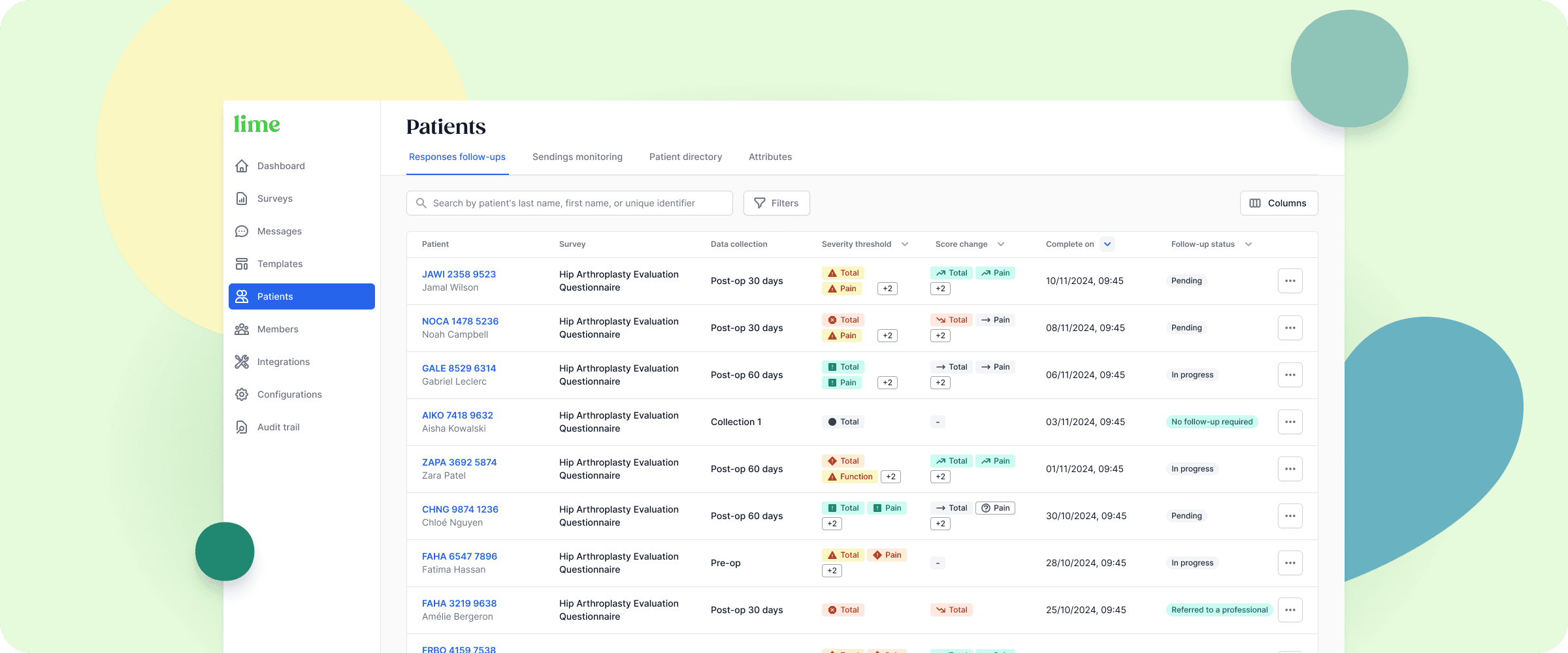
Caption: "The Lime dashboard: a consolidated view of all patients, featuring real-time severity and deterioration alerts."
Each response is automatically analyzed using two complementary types of indicators.
Each facility configures its own thresholds based on its clinical standards. When a patient reaches these thresholds, they are automatically flagged as requiring quick attention, allowing the team to prioritize interventions.
Severity thresholds:
🔴 Severe
🟠 High
🟡 Moderate
🟢 Low
⚪ None
Differences between collection steps:
📉 Deterioration: the patient’s condition has worsened
➡️ Stability: the patient's condition is unchanged
📈 Improvement: the patient’s condition is improving
An administrative officer reviews these results daily and coordinates the appropriate interventions—physiotherapist, pharmacist, nurse, or specialist consultation—based on each patient's profile.
2. Individual patient results analysis
By opening a patient's file, clinical staff can access a complete longitudinal analysis: the evolution of total score, pain, and function at each point of measurement, along with automatically calculated severity thresholds and clinical score changes.
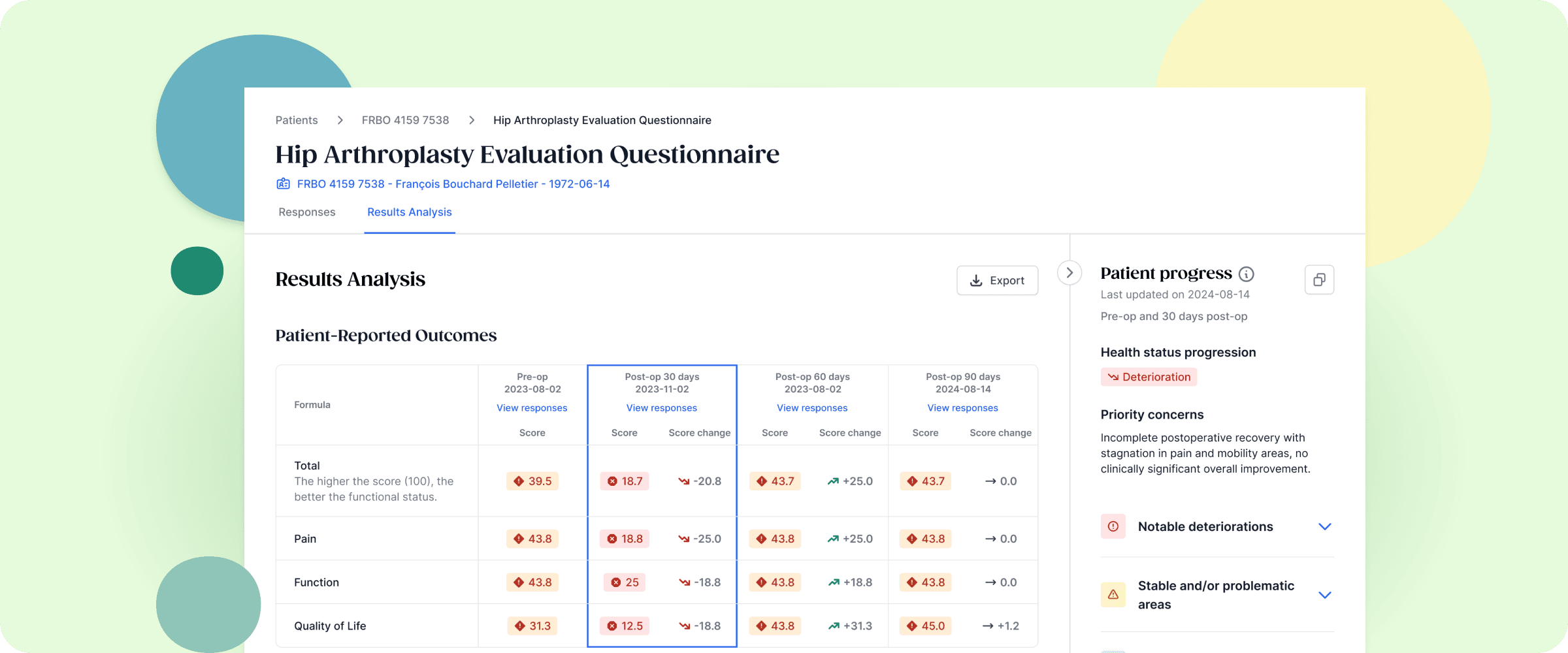
Caption: "Lime’s longitudinal analysis: view the patient's progression over time, with significant changes clearly highlighted."
The platform also generates a summary of high-priority concerns, such as a rapid decline in functional autonomy between assessments. This allows clinicians to act quickly without needing to review every single question manually.
If a patient's condition does not improve despite clinical interventions, a surgical reprioritization process is triggered with the medical team to adjust the surgery date if necessary.
3. Response details and interprofessional referrals
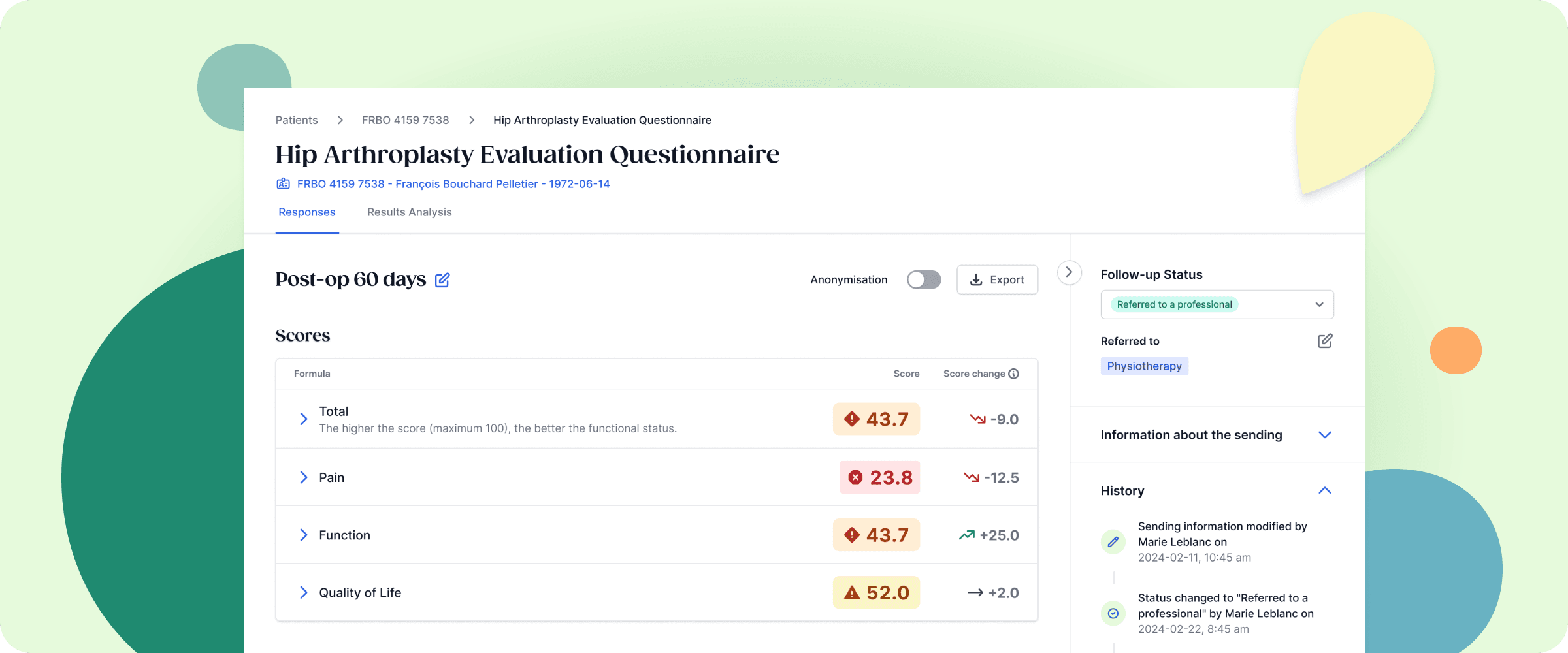
Caption: "Every response can be viewed in detail, and follow-up status is updated in real time by the team."
Every completed questionnaire is automatically exported to the electronic medical record (EMR) of the CHU. This eliminates duplicate data entry and ensures seamless continuity of information between follow-up staff and care teams.
4. Performance dashboard
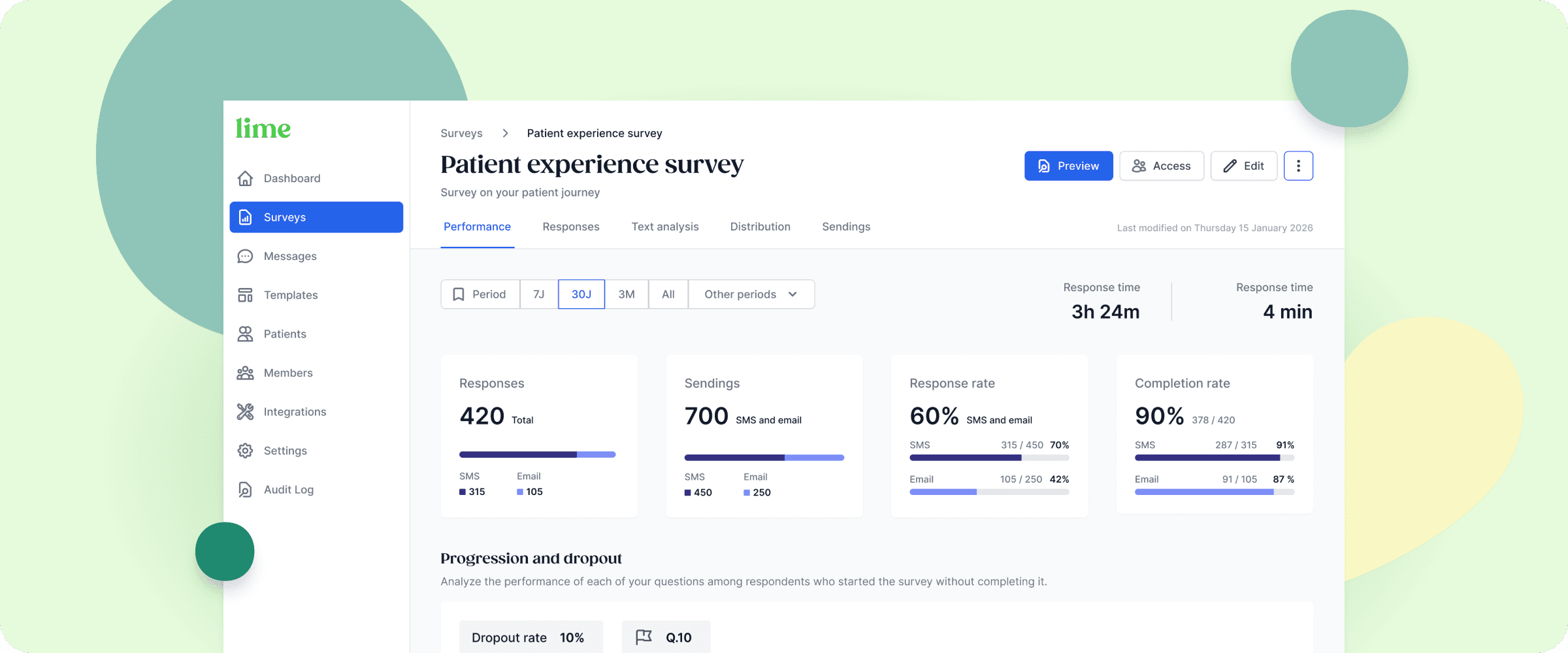
Caption: "Real-time performance tracking: response rates, turnaround times, and completion rates by delivery channel."
The CHU team monitors data collection performance indicators continuously: response rate, completion rate, average completion time, and distribution by channel (SMS or email). This data helps adjust delivery strategies and improve patient engagement over time.
Numbers that speak for themselves
The rollout quickly demonstrated its impact on both patient experience and clinical operations.
On patient engagement:
✅ 60% response rate on the first delivery to 700 patients within 8 hours, compared to 25-30% with traditional methods
✅ 90% completion rate once the patient started filling out the questionnaire
✅ This high rate of participation confirms a clear desire among waiting patients to be heard and supported
On patient experience:
✅ +30% overall improvement in patient experience, validated by a statistician
✅ Measurable benefits regarding physical comfort, information provided, and family involvement
✅ Patients feel less isolated and better supported, which reduces anxiety during the waiting period.
On clinical management:
✅ Early identification of deteriorating patients, allowing targeted interprofessional interventions
✅ Surgical reprioritization based on objective data rather than arbitrary inbound calls
✅ Reduction in the volume of unstructured administrative phone calls
During the initial launch, emergency messages were identified within the responses. The team immediately responded by creating a dedicated communication channel, "Mon Genou, CHU de Québec", for urgent situations. This is a concrete example of the benefits of active monitoring for patients on waiting lists.
The fundamental shift of this project
Beyond the statistics, this project represents a philosophical shift in managing surgical waiting lists.
Waiting lists are often viewed as passive administrative registries—empty space between booking and surgery. The CHU de Québec has proven that this phase can be transformed into an active clinical stage: a time for monitoring, early intervention, and optimization before surgery.
The project required strong organizational commitment: redefining clinical roles, adopting digital tools slowly but surely, and managing change. However, it establishes a framework that is highly adaptable to other specialties and other waiting lists.
What if your healthcare facility did the same?
The care pathway established by the CHU de Québec with Lime Santé is designed to be highly reproducible. Whether in orthopedics, bariatric surgery, oncology, or elsewhere, the core principles remain identical: collect the right PROMs data at the right time, make it actionable in real time, and enable clinical teams to intervene before a situation deteriorates.
Would you like to explore how PROMs can transform waitlist management at your facility?
FAQ: PROMs and surgical waiting lists
What are PROMs?
PROMs (Patient-Reported Outcome Measures) are standardized questionnaires completed directly by the patient. They measure dimensions such as pain, physical function, and quality of life at various points throughout the care pathway.
Which questionnaires are used at the CHU de Québec in orthopedics?
The CHU de Québec uses the Oxford Hip Score (OHS) for hips and the Oxford Knee Score (OKS) for knees. Both PROMs are recommended as national standards for joint replacements by CIHI.
When are the PROMs sent to patients?
The questionnaires are sent when patients join the waiting list (Day 0), and then at 7 days and 3 months. An additional 6-month assessment is added based on patient progress.
What results did the CHU de Québec achieve?
A 60% response rate on the first delivery in under 8 hours, a 90% completion rate, a +30% overall improvement in patient experience, early detection of patient deterioration, and data-driven surgical reprioritization.
How does the Lime platform integrate with hospital systems?
The Lime platform connects to the facility’s HL7 messaging system to automate delivery, and exports each completed questionnaire to the electronic medical record (EMR).
Is this approach applicable to other specialties?
Yes. The same principles apply to bariatric surgery, oncology, and other clinical pathways: collecting the right data at the right time, analyzing it in real time, and enabling care teams to act before situations deteriorate.
This article was written in collaboration with the team from the CHU de Québec-Université Laval.