June 3, 2025
Health: how qualitative data transforms the patient experience
Patient experience and PREMs
Francis Robichaud
Lime Health Founder and CEO
The Crucial Role of Qualitative Data in Enhancing Patient Experience in Healthcare
It has never been more essential to rapidly improve the patient experience than in the current healthcare context. Faced with increasing complexity and ever-greater resource constraints, leaders and decision-makers are constantly seeking solutions to overcome challenges and improve interactions between healthcare professionals and patients, as well as the latter's care outcomes.
Patient Feedback as Leverage for Improvement in Healthcare
A proven strategy involves using patient feedback to highlight areas of friction and levers for improvement, as well as to emphasize what works well.
Patient feedback is traditionally collected through quantitative measures. While these are useful for observing trends and enabling comparisons between different groups of respondents, research increasingly shows that qualitative feedback from patients contains the most valuable information and has the potential to transform healthcare experiences through the concrete actions they make easier to identify.
A study published in BMJ Open highlighted the direct influence of qualitative patient feedback on quality improvement initiatives in hospitals, as this feedback includes detailed comments on various aspects of patient care and thus leads to specific actions such as improving meal quality, reducing wait times, or enhancing the overall comfort of patients [1].
An analysis in the Journal of Public Health highlighted the impact of patient comments on their overall healthcare experience. The qualitative feedback from patients regarding their sense of safety, the effectiveness of treatments, and the smooth transition between different care contexts is crucial for enabling healthcare providers to understand and respond more effectively to patient needs [2].
Example of Relevant Qualitative Data for Patient Experience
The following example perfectly illustrates the relevance of qualitative data: a commonly asked question in experience surveys is, “During this visit/stay in the hospital, were you treated with dignity and respect?”.
While aggregated quantitative responses may help an organization better understand patients' general perception, they lack the detailed information necessary to lead to specific improvements.
By asking a follow-up qualitative question such as, “Please explain why you gave this rating”, patients can articulate the specific aspects of their experience that contributed to their feelings. These detailed responses therefore provide organizations with information that enables them to take action.
In the example above, patients might report in their comments that healthcare providers seemed rushed, did not address them by name, and rarely drew the curtain when providing care.
These tangible details can guide team member training and allow organizations to focus on the aspects of care that matter most to patients, thus contributing to more positive outcomes.
The Beneficial Effects of a Better Care Experience on Patient Health are Well Documented
The effects include:
✅ Increased trust and better communication between the patient and the care teams;
✅ A greater adherence to treatment plans;
✅ A reduced risk of safety incidents.
Given the complementary nature of quantitative and qualitative feedback, organizations must invest in robust processes for collecting, analyzing, and utilizing patient feedback to significantly improve experiences and outcomes.
Leveraging Qualitative Data in Healthcare Despite Time and Resource Constraints
Despite the invaluable nature of qualitative data, we recognize that their collection, analysis, and categorization can prove extremely time-consuming and arduous in the current healthcare context.
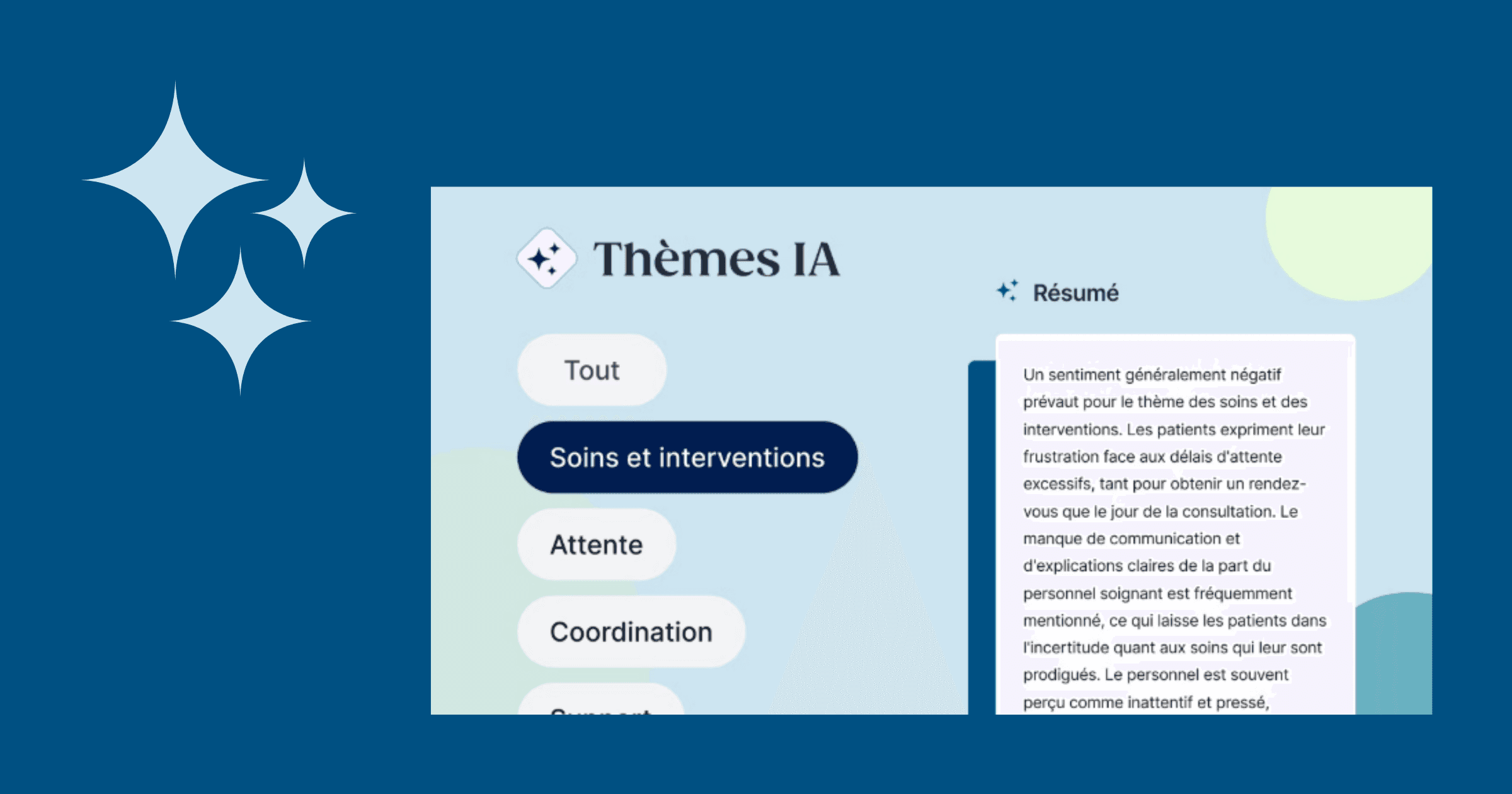
At Lime, we aim to help our clients maximize the value of patient feedback while reducing the workload of healthcare teams. That’s why we recently launched the first version of our AI-assisted text and sentiment analysis tool. This enhancement enables our clients to make the most of qualitative data by:
✅ Extremely accurate text analysis;
✅ Categorizing responses into various sentiments ranging from “positive” to “negative” to “mixed”;
✅ Breaking down comments into excerpts to more clearly reflect the different feelings and themes expressed;
✅ Ranking different excerpts according to specific patient experience themes such as patient safety, communication, or wait times. This thematic breakdown allows for the quick identification of the topics most commonly addressed by respondents.
Our text and sentiment analysis tool is designed to help healthcare organizations harness the full potential of patient feedback by facilitating the identification of areas for improvement as well as successes.
At Lime, we are committed to continuously improving our tools to better meet our clients' needs and support the mission of providing exceptional care to patients. Learn more about our PREMs solution.

Sources:
Berger S, Saut AM, Berssaneti FT. “Using patient feedback to drive quality improvement in hospitals: a qualitative study”. BMJ Open 2020;10:e037641. doi:10. Online: https://bmjopen.bmj.com/content/bmjopen/10/10/e037641.full.pdf
Adams C, Walpota R, Pervaz Iqbal M, Schembri A, Harrison R. “The three pillars of patient experience: identifying key drivers of patient experience to improve quality in healthcare”. Journal of Public Health https://doi.org/10.1007/s10389-023-02158-y. Online: https://link.springer.com/article/10.1007/s10389-023-02158-y